
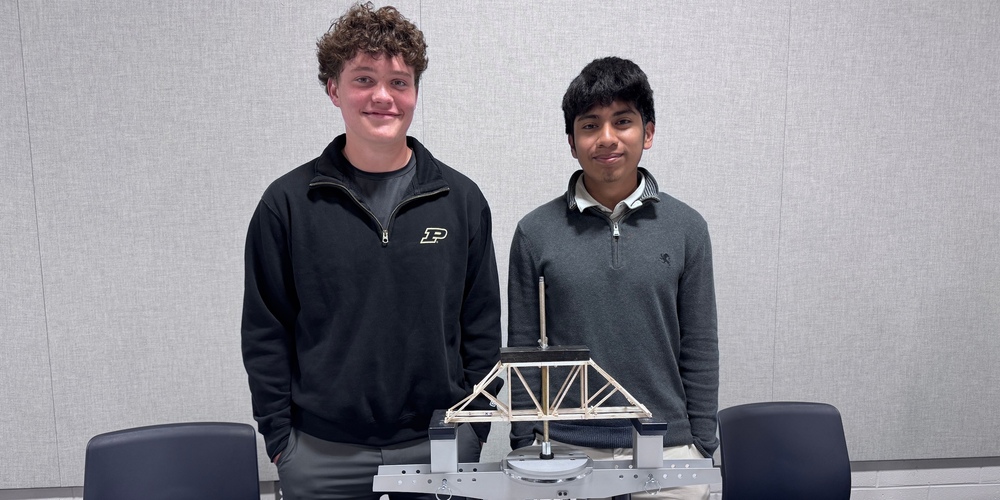
When most people look at a bridge made from thin wooden sticks, they see a simple structure. Harrison Slaven and Asriel are looking for something much more. Every tiny adjustment, every reinforcement and every design choice could mean the difference between success and failure when they compete at the Technology Student Association National Conference this month.
The iLEAD Academy students have spent months refining their bridge design for the TSA Structural Design and Engineering competition, a challenge that requires teams to build lightweight structures capable of holding impressive amounts of weight.
"Our goal is to get the most efficient structure possible," Harrison said. "We started with a really basic design and kept iterating off that."
Unlike last year's tower competition, this year's bridge challenge demands constant improvement and testing.
"Last year we had a jig that carried us all the way," Harrison said. "This year we actually have to keep iterating and improving our design. We started with a really basic design and then tested it. Wherever something broke, we would reinforce that and make adjustments."
That process has led to approximately 15 different bridge versions.
"A lot of it looks like small tweaks, but they really change the whole thing," Harrison said. "We added spacers that helped a lot because we were having issues with buckling and parts falling apart during testing."
Asriel Aguazul Mendoza described the project in simpler terms - "A lot of trial and error.”
The pair's dedication has already produced impressive results. They captured first place at both the regional and state TSA competitions.
"Our regional bridge won by almost 100 pounds," Asriel said. "Then at state, our pre-built bridge didn't hold as much as we thought it would, but our on-site bridge did really well."
Success at state reinforced the team's confidence while also reminding them that national competition will bring tougher challenges.
"We look forward to nationals because we'll see more quality bridges and more competition," Asriel said.
Part of what makes the team successful is their ability to work together efficiently during the on-site portion of the event. Teams have just three hours to design and build a new structure based on a modified prompt.
"We really go over the plan of how we built the pre-built structure," Harrison said. "The prompt is different, but not that much different. They want you to show you can alter your design and still do well."
Clear responsibilities help maximize every minute.
"I handle cutting measurements and Harry assembles," Asriel said. "We try to keep ourselves busy. He has his task and I have mine, so we're not running into the same problems."
Despite competing on a national stage, the students say the atmosphere is less intimidating than many people imagine.
"When we got to nationals last year, we were really nervous," Harrison said. "But once we got in there, we calmed down."
"It isn't as quiet as you'd expect," Asriel added. "There's a lot of background noise. You hear people talking and cutting."
As the national competition approaches, both students know predicting the outcome is impossible.
"It's really a toss up," Harrison said. "We know our bridge is good, but there are a lot of other places that do really well. We'll just do the best that we can."
That attitude reflects the journey that brought them this far. What started as a project they joined because no one else was doing it has become one of their favorite TSA events.
"We did it last year because we needed another project," Harrison said. "It turned out we were good at it and we liked it, so we kept doing it."