
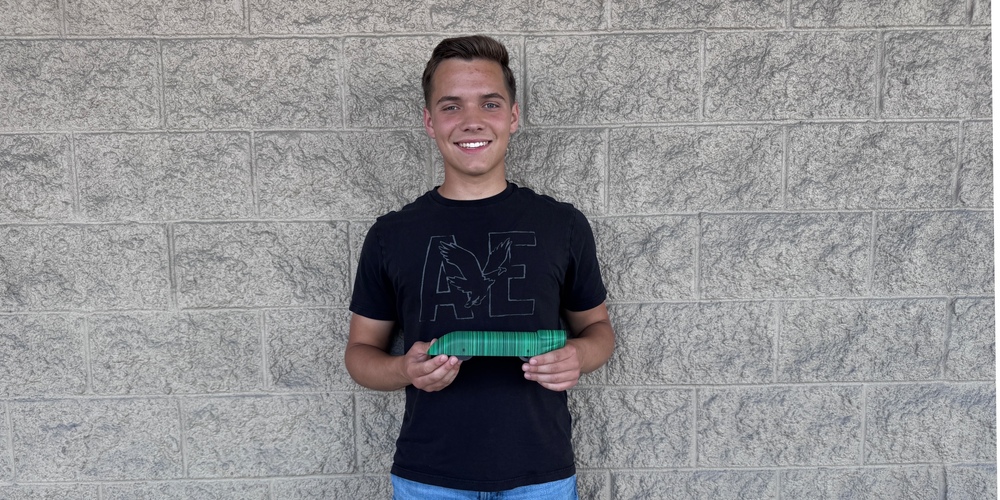
Every fraction of a second matters when Evan Alsup's dragster races down the track.
The Carroll County High School and iLEAD Academy student has spent the past three years refining his approach to Technology Student Association dragster design, learning how small adjustments can make a big difference. His hard work paid off this year when he captured first place at the Kentucky TSA State Conference and earned another opportunity to compete at the national level in Washington, D.C.
"It's sort of like a Pinewood Derby car, but it uses CO2 instead of gravity to travel," Evan said. "I design it in Fusion and then 3D print it."
Each year, TSA changes the competition requirements, forcing students to adapt their designs. Evan said this year's rules created a different challenge than previous competitions.
"It was easier this year because it wasn't as focused on weight," he said. "It was more design oriented, which made it more competitive."
That shift allowed him to focus on aerodynamics and efficiency. His latest dragster features wheels mounted inside the body to reduce drag and air resistance while also creating a stronger overall structure.
"Last year at nationals, one of my wheels broke from the stopping system," Evan said. "This year I was trying to make it stronger and more aerodynamic and minimize all the places air could get into it."
His attention to detail extends well beyond the body design. Evan even creates his own wheels and axles using a 3D printer.
"I made the wheels a little wider," he said. "That decreases axle friction and helps it run smoother. I'm trying to make the wheels as small as possible to lower wheel inertia. I want the body moving fast, not the wheels."
Although the finished product appears simple, the design process involves plenty of experimentation and revision.
"I probably had about three iterations of this one," Evan said. "One version tapered in the middle and came back out. It helped with the weight, but I didn't want it to increase drag."
The learning process has helped him improve from year-to-year. Last season, a broken wheel at nationals prevented him from reaching his full potential. Even so, he finished 40th in the nation.
This year, he believes he has a stronger design and a better understanding of the competition.
"Last year I was third seed at state. This year I was first," he said. "I'm hoping to make the top 16 at nationals."
National competition begins with a time trial, where dragsters race 20 meters in just over a second. The fastest 16 entries advance, provided they pass a detailed inspection to ensure they meet all competition requirements.
Speed is important, but it is not the only factor judges consider.
"It's not just about speed," Evan said. "Last year I had the third-fastest car, but I got second place in state because I had better attention to detail."
That attention to detail became especially important during this year's state competition. Standing in line before the event, Evan found himself sizing up the competition. "I was worried," he said. "Everybody had great dragsters this year."
Even after years of experience, the excitement and nerves never completely disappear.
"It's a little nerve wracking," he said. "I looked at the tournament online and got kind of scared that it might break. It didn't, but I was worried about it."
As he prepares for another trip to nationals, Evan continues making small improvements and testing new ideas, but he is ready to see how his dragster stacks up against some of the best student engineers in the country.