Winning a state championship sometimes starts by admitting your first idea wasn't the best one.
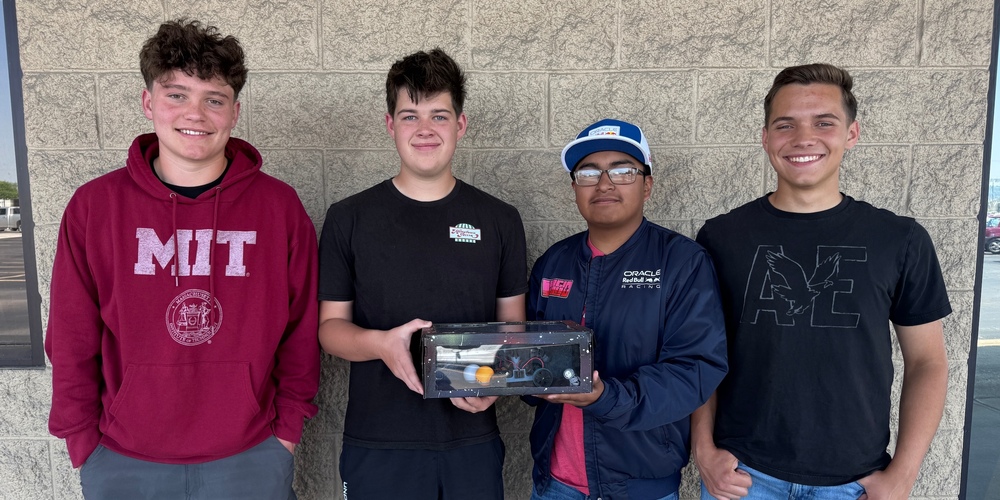
When a Cybertruck-inspired design proved too heavy to compete, Harrison Slaven, Evan Alsup, Jayden Brentlinger and Chris Malo went back to the drawing board. The result was a redesigned solar-powered vehicle that captured regional and state titles and earned the iLEAD Academy students a trip to the Technology Student Association National Conference this month.
The event challenges students to design, build and race a solar-powered vehicle over a 20-meter course while balancing speed, efficiency and engineering precision.
"It's similar to the dragster competition," Evan said. "The race style is 20 meters and uses a similar bracket format. We have required components like the motor, solar panel and batteries, but there aren't many dimension requirements. There's a maximum size, but other than that you can make it as small as you want."
That flexibility gave the team plenty of opportunities to experiment after realizing their initial concept would not succeed. "We started with a Cybertruck-style design," Evan said. "It was too heavy. We realized pretty quickly it wasn't going to be competitive."
The team shifted its focus away from appearance and toward performance. After multiple redesigns, the students developed a much lighter vehicle featuring a minimal frame, motor mounts and specially designed supports.
"This one had three different designs," Chris said.
Evan added that "Optimizing all the little details is what really matters. Originally it was just a plain frame. The gears were moved around and several things changed as we kept improving it."
One lesson came from last year's national competition. The team had created an adjustable solar panel system that could follow the sun's position. The idea worked well until it didn't.
"We added a piece that could move the solar panel toward the sun," Chris said. "At nationals last year it ended up moving too far and hit the floor, which stopped the vehicle during one of our runs."
This year, they added limits to prevent the same issue from happening again.
Their success has not come by accident. Every team member contributes ideas throughout the design process by making their own concept sketches before they settle, as a group, on their final concept.
The team credits part of its motivation to watching previous Carroll County students succeed in the same competition.
"We had seen another group from our school win first place," Harrison said. "We thought if we competed, maybe we could do the same thing."
Now, after months of designing, testing and refining, the group is preparing for another trip to nationals. Alongside their racing vehicle, they also created a display featuring a space theme complete with LED lighting, a painted backdrop and a design that resembles a Mars rover.
The students know the competition will be tough, but they are entering with confidence.
"I expect us to place," Chris said.
"We think we can finish in the top 10 this year," Harrison added.