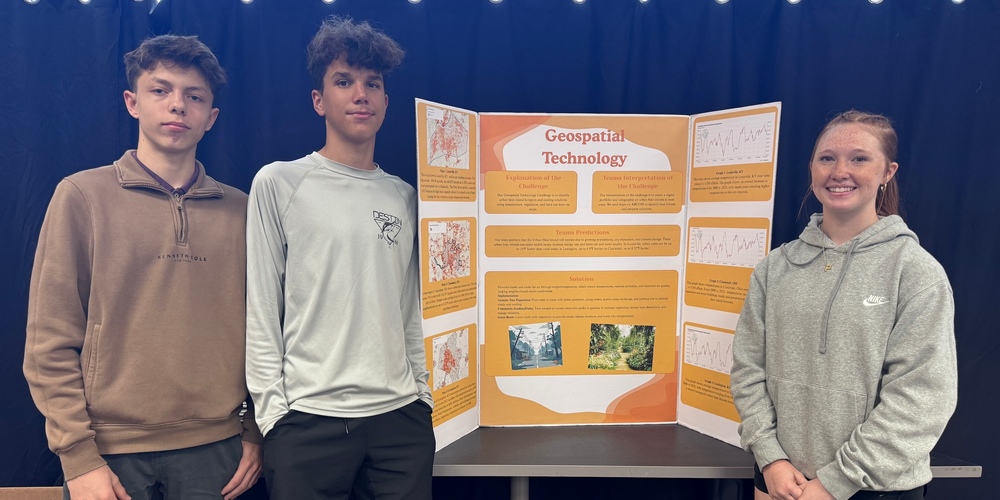
When Peyton Perkins, Dorian Obando and Dallas McGuire began researching hot spots in Louisville, Lexington and Cincinnati, they were simply completing a class project. A few months later, the iLEAD Academy freshmen are preparing to present their work on a national stage.
Their study of urban heat islands has earned them a trip to the Technology Student Association National Conference, where they will compete against some of the top student researchers in the country.
The project focused on urban heat islands, a phenomenon that causes certain areas within cities to become significantly warmer than their surroundings.
Using mapping tools and publicly available data, the students identified areas that experienced higher temperatures and researched ways communities could help reduce the heat.
"It was mostly data collection and mapping," Dorian said. "We chose hot spots in the cities and then provided solutions."
The team focused on three main recommendations: increasing tree populations, creating green roofs and expanding parks and community gardens.
As they dug deeper into the project, the students learned how urban development can contribute to rising temperatures.
"Urban heat islands are caused by things like buildings trapping heat," Dallas said. "The urbanization within some of these cities was pretty significant."
Although the topic was complex, the students worked to present their findings in a way that was easy to understand. Their competition entry included documentation, maps, data analysis and a visual display highlighting their research and proposed solutions.
Success in the competition depends on more than the quality of the research. Judges also evaluate how effectively students communicate their work through presentations and visual materials.
At the national level, teams first submit documentation. Projects selected as semifinalists move on to additional judging, including presentations and an infographic component.
The students have spent the weeks leading up to nationals refining every aspect of their project.
"When we went to state, the judges gave us critiques," Dorian said. "We've been improving based on that feedback."
The team also sought advice from teachers and community members during project showcases.
"We wanted as much feedback as possible so we could do better," Dallas said.
That willingness to listen and improve has helped strengthen both the project and the team's presentation skills.
Regardless of the final results, the students recognize how special the experience already is.
"I think it's just cool that we get to go as freshmen," Peyton said. "Being a freshman and going to nationals is pretty cool."